Wanderstar Marketing in partnership with Startup Grind put together the Next Orbit virtual event series for Series A/B startups and small businesses in the space industry. Each session brought in a seasoned expert to tackle one of the areas where early-stage space companies most often get stuck: fundraising, sales and marketing alignment, and scaling operations. The conversations are practical by design, and available on YouTube as an ongoing resource for space founders.
In this session of the series, Daniele Dallari and I broke down what actually closes that gap, not theory, but the processes, mindset shifts, and practical frameworks that work in the real world.
Why Sales and Marketing Misalignment Kills Deals in Space Companies
We opened with something most founders and operators have lived through: the moment you realize sales and marketing are optimizing for completely different things or worst of all, talking to different audiences.
For space and high-tech companies, this is compounded by the complexity of the sale itself. You're often selling to technical buyers who need education, decision-makers who need confidence, and procurement teams who need process…sometimes all at once. Marketing has to carry more of the load earlier in the cycle than most teams realize.
The Beliefs That Have to Come First
Before tactics, Daniele and I spent time on the foundational beliefs that make alignment possible. This part of the conversation is easy to skip - most people want the checklist - but it's where the real work is.
The core idea: sales and marketing can't collaborate on tactics if they don't agree on what they're building toward. That means shared definitions (what is a qualified lead?), shared accountability (who owns what part of the funnel?), and - critically - shared respect for what each function actually contributes.
In early-stage space companies especially, this often means sales needs to trust that marketing is building something that will compound over time, even when results aren't immediate. And marketing needs to stay close enough to real sales conversations that it's building content for actual objections, not imagined ones.
The Four-Step Playbook: Turning Belief Into Behavior
The centerpiece of the session was a practical, four-step framework for turning alignment from a principle into a process. This is the part you can take back to your team Monday morning.
Step 1: Define the shared Ideal Customer Profile (ICP)
Not "who do we think we're selling to" - but a documented, agreed-upon profile of the customer that both teams use as their north star. If marketing is building content for one audience and sales is pitching a different one, nothing will stick.
Step 2: Map the content to the conversation
Sales conversations follow a predictable arc - awareness, consideration, objection, decision. Marketing's job is to have the right asset ready at every stage. This step is about auditing what exists and identifying the gaps. What does a prospect ask in the first call that hasn't been addressed yet in marketing material?
Step 3: Build the feedback loop
This is the part most companies skip. Sales needs a simple, low-friction way to tell marketing what's working and what isn't. Not a quarterly review, but a real feedback loop that runs continuously. What content is getting forwarded? What questions keep coming up that nobody has a good answer for?
Step 4: Tie it to a shared metric
Marketing vanity metrics and sales pipeline metrics don't have to be in competition. Pick one number that both teams own…qualified pipeline generated is a common one…and hold everyone accountable to it. When there's a shared scoreboard, the incentive to collaborate takes care of itself.
How to Sustain Alignment as an Operating Model
Alignment isn't a project with an end date, but an operating model really. The companies that do it well don't get there through a single offsite or a reorg. They build small habits: a weekly sync, a shared doc, a standing question in the sales debrief.
For space and high-tech startups, where the market is still being educated and relationships are the real competitive advantage, getting this right early is one of the highest-leverage things a founding team can do.
Watch the Full Session
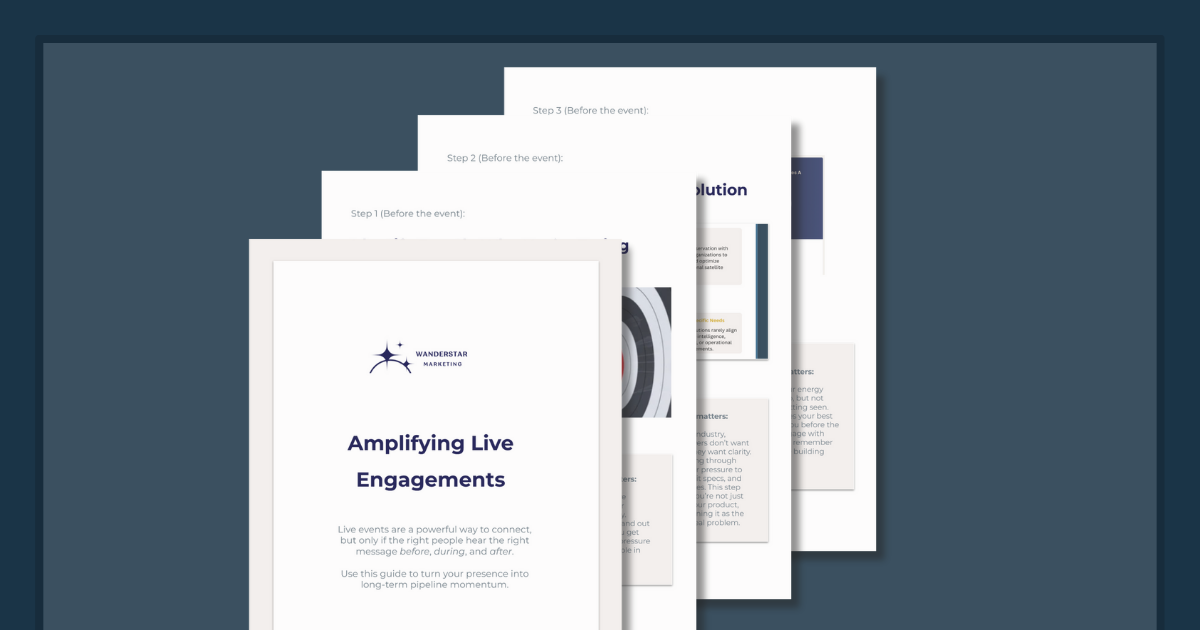
The full recording is available on the Startup Grind YouTube channel. If you want to go deeper on the framework we walked through, the Sales & Marketing Alignment Playbook is available as a free download in the Resource Hub - it includes the templates and tools referenced in the session.
Download the Free Sales & Marketing Alignment Playbook for Space Startups
Wanderstar Marketing builds marketing foundations for space and high-tech companies, so your team can focus on growth.
Book a strategy session here to get started.


.png)